11 Foods That Make Your Erections Harder
Nitric oxide is made in our bodies and it helps to dilate our blood vessels, and we actually make less nitric oxide as we age. A decrease in nitric oxide can actually lead to things like decreases in heart health, arterial health and even something as serious as erectile dysfunction.
One of the best ways to boost nitric oxide in your body is to eat foods that are high in nitrates, and in this article I’m going to share with you the 11 best foods to boost nitric oxide.
Now, our body actually has two pathways for producing nitric oxide. It has the L-arginine pathway, which is where our body converts L-arginine into nitric oxide, and we can actually lose up to 85% of the function of this pathway as we age.
To help improve nitric oxide production through this pathway, I personally take L-citrulline supplements, which I have found to be very effective. Not only does this supplement seem to make my workouts at the gym easier and my recovery times better, but I’ve also noticed an improvement in my erections. They’re easier to get, they tend to be harder when they come and they stick around for longer.
It’s one of my favorite supplements to take, and if you’re suffering with erectile dysfunction, then I put together a full list of the supplements that I take to help boost my erections. You can go to passionately.com/ed to get access to that list. In that list I also share the studies behind each of the supplements and why they work, and I regularly update the list as well.
Now, the second pathway that our body uses to produce nitric oxide is from the food we eat. When we eat food high in nitrate, our body then converts that nitrate into nitrite in our biome and then converts that nitrite into nitric oxide.
We actually have special bacteria in our mouth, in the folds of our tongue, that help convert the nitrate into nitrite. For this reason you should avoid oral mouthwash, as it can wipe out these bacteria and stop this conversion from happening as effectively.
So to boost the nitric oxide in our body, one of the best ways to do that is to eat foods high in nitrates. A regular person who eats the average Western diet isn’t consuming nearly enough nitrate. They’re likely getting 40 to 100 mg of nitrate per day, where really it’s recommended that you get more in the range of 300 to 400 mg of nitrate per day.
Interestingly, in this situation organic vegetables actually contain less nitrates than regularly grown vegetables. This is likely because regular vegetables use nitrogen-rich fertilizer, but also the level of nitrate in the food can vary wildly between regions, depending on where it’s grown and what conditions it’s grown under.
Studies have shown that consuming food high in nitrates and nitrites can improve athletic performance in the form of VO2 max. It helps to improve artery health, it helps to lower inflammation, it helps to dilate our blood vessels, which is needed for erections, as well as helping to relax the corpora cavernosa, which is the smooth muscle in our penis that needs to be relaxed in order to get an erection.
Eating food high in nitrates also helps to reduce erectile dysfunction in people with mild to moderate erectile dysfunction. It can enhance exercise and recovery, it can improve mitochondrial function and even lead to less heart attacks and less strokes. So there’s a lot of benefits of eating food high in nitrates, but what exactly are the best foods to eat?
First, a quick note on processed meats and deli meats, which are actually high in nitrate. Things like ham, bacon, hot dogs, deli meats: they use nitrate in order to preserve the meats, but unfortunately in these meats the nitrates and the nitrites can be converted into nitrosamines, which are thought to be carcinogenic.
So generally speaking, you want to get your nitrate from vegetable sources. Vegetables are much less likely to have nitrosamines, and also they contain antioxidants like polyphenols and vitamin C, which help to convert the nitrite into nitric oxide in our bodies.
So here’s my list of the 11 best vegetables that you can eat to boost your nitric oxide.
11. Whole Beets
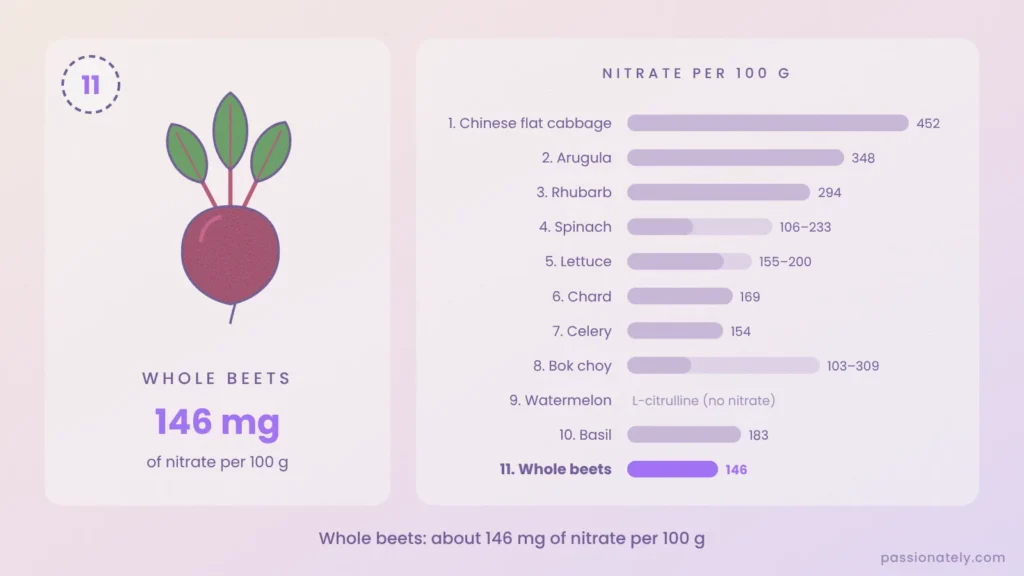
While you may have heard that beet juice is really high in nitrates, and this is true, whole beets themselves come in at number 11 on the list. They have roughly 146 mg of nitrate per 100 g.
10. Basil
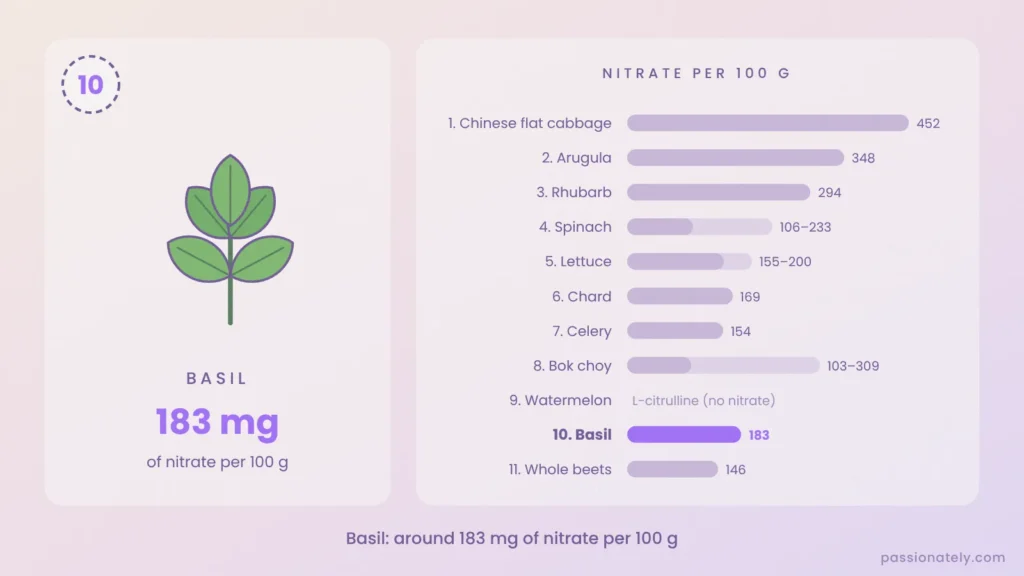
Basil has around 183 mg of nitrate per 100 g.
9. Watermelon
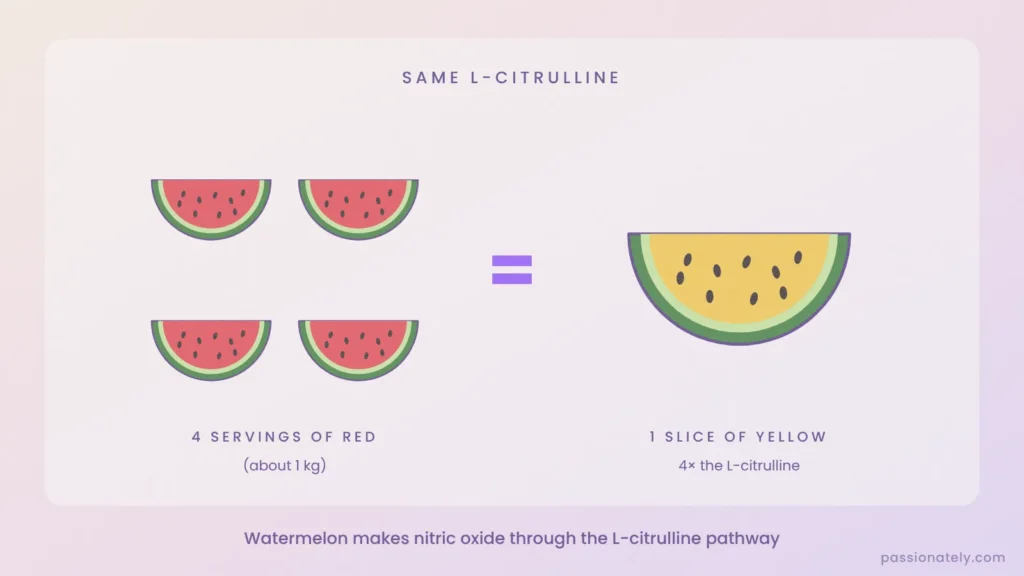
Watermelon isn’t high in nitrate, but rather it’s high in L-citrulline, which creates nitric oxide through the other pathway that we talked about.
The average watermelon contains somewhere between one and five grams of L-citrulline per kilogram of watermelon, with yellow watermelon having four times the amount of L-citrulline compared to red watermelon.
So if you want to boost erectile function, then just one slice of yellow watermelon can be enough to give you a good amount of L-citrulline, whereas you’re going to need around a kilogram, or four servings, of red watermelon in order to get the same amount of L-citrulline.
8. Bok Choy
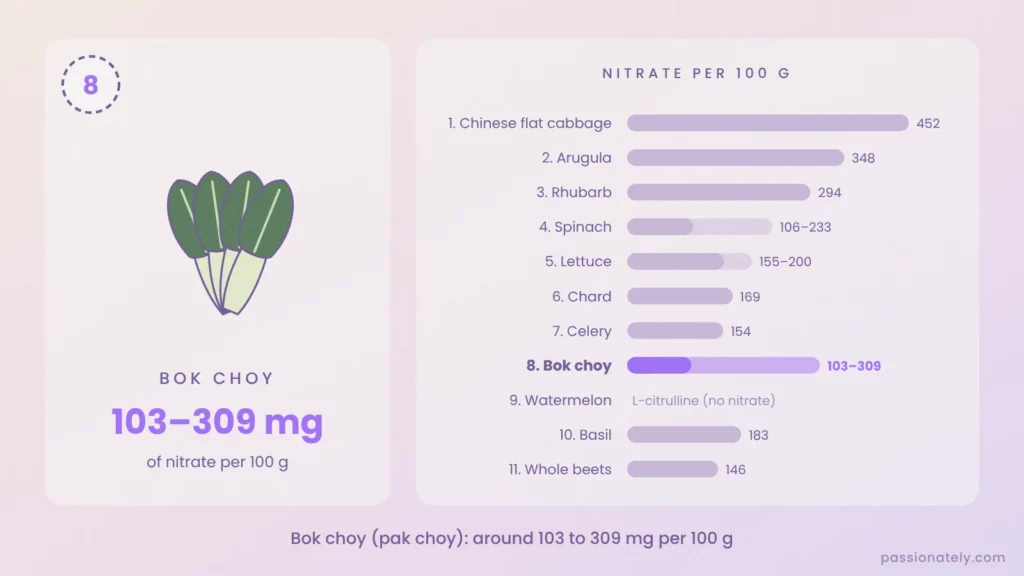
Bok choy, also known as pak choy, has around 103 to 309 mg of nitrate per 100 g.
7. Celery
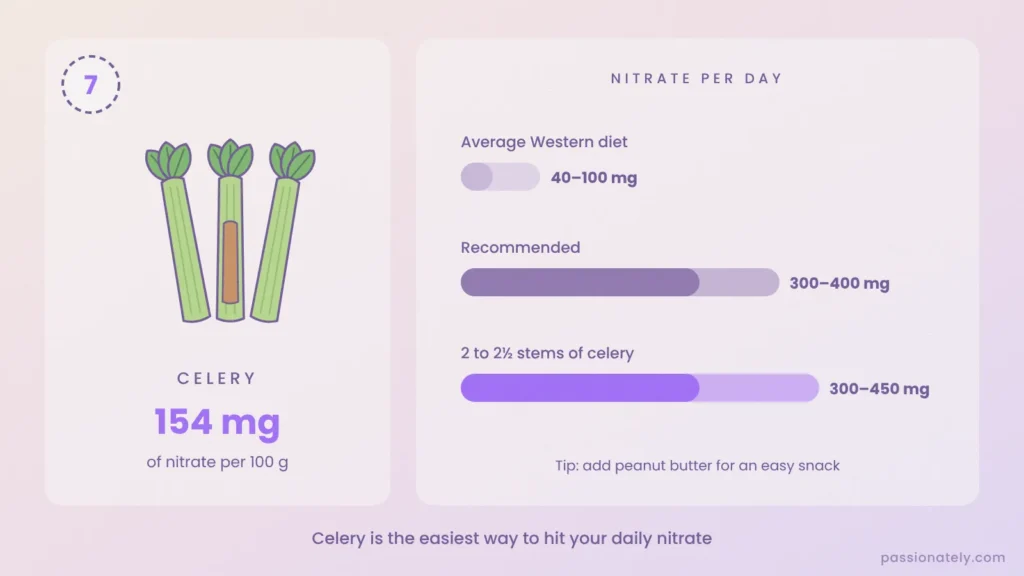
Celery is actually my favorite way of getting my daily dose of nitrates. It has around 154 mg per 100 g of celery, but the reason that I like it is it’s so easy to eat in high volumes compared to things like leafy greens.
Just two to two and a half stems of celery is going to give you around 300 to 450 mg of nitrate. I love putting some peanut butter on my celery and it makes a great snack.
6. Chard
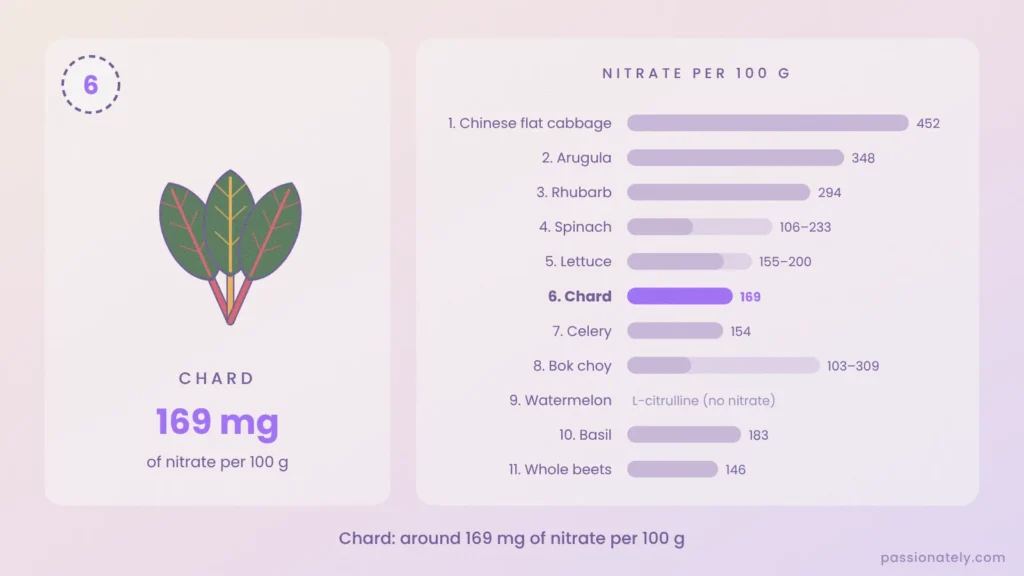
Chard has around 169 mg of nitrate per 100 g.
5. Lettuce
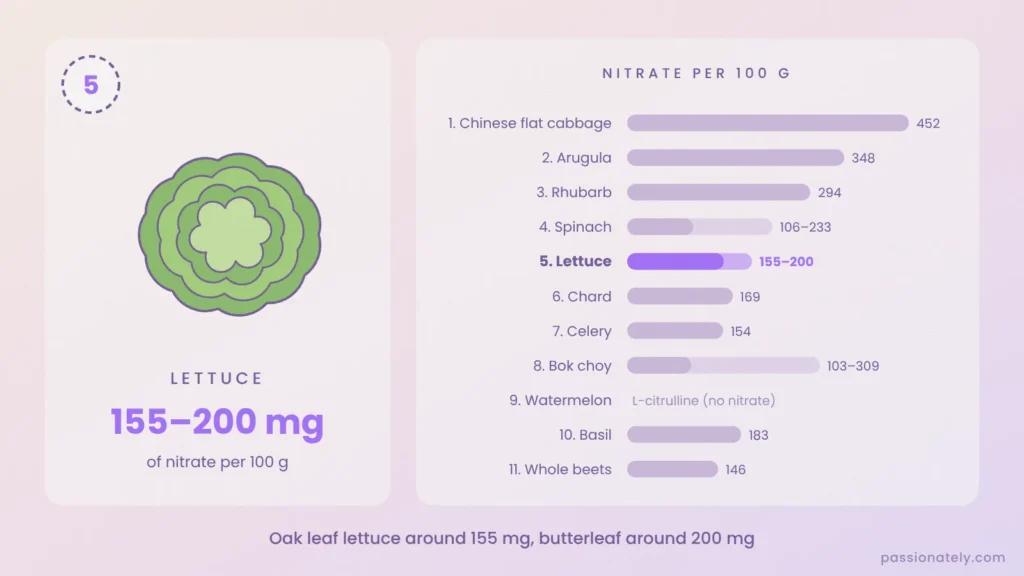
Something like oak leaf lettuce has around 155 mg of nitrate per 100 g, and something like butterleaf lettuce has a whopping 200 mg of nitrate per 100 g. There’s also a wide variety of other lettuces that are high in nitrate as well.
4. Spinach
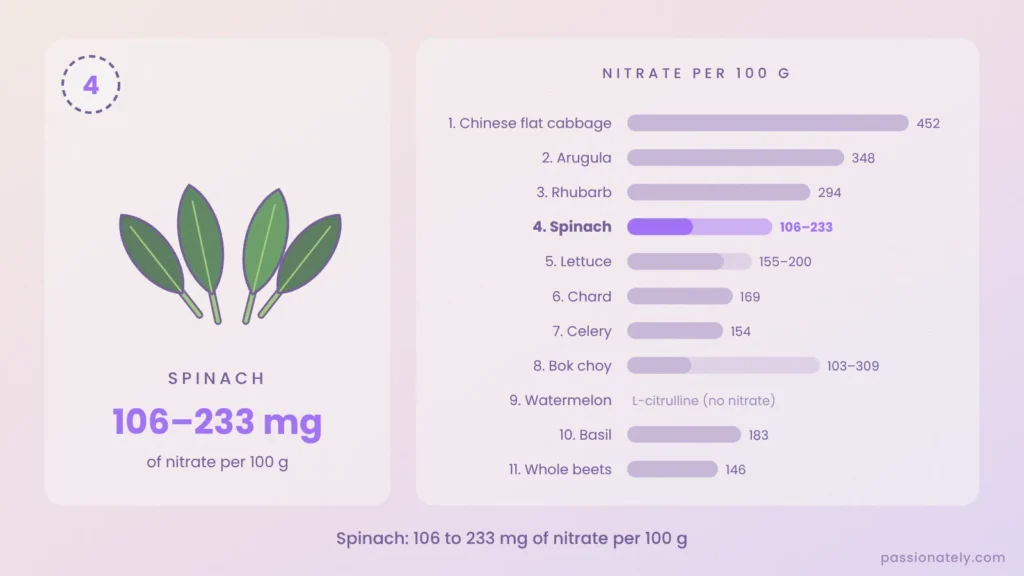
Spinach has 106 to 233 mg of nitrate per 100 g. As with all of the items on this list, where it’s grown is going to determine its nitrate level, but I absolutely love spinach with my wraps, in salads, with egg and avocado toast. It’s a great source of nitrates.
Beet Juice
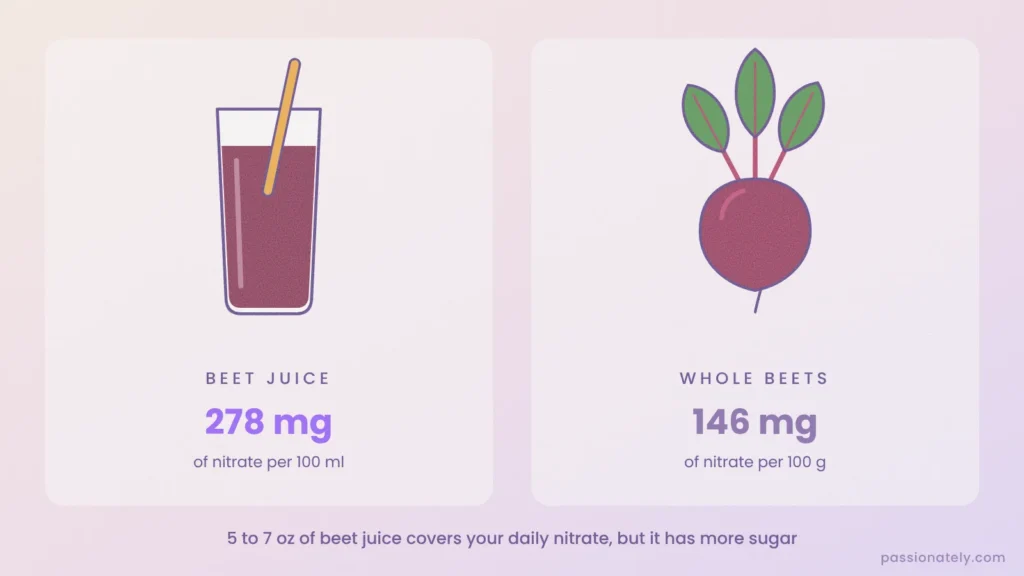
While beets were only 11th on the list with 146 mg of nitrate per 100 g, beet juice has a much higher concentration of nitrate, with around 278 mg of nitrate per 100 g, or 100 ml.
This means you can get your daily nitrate intake from around five to seven ounces of beet juice, but obviously it’s going to have a higher concentration of sugar, which isn’t as good as eating the full vegetable. There’s also a variety of beet juice supplements out there as well that are extremely high in nitrate, and you can get your daily dose from an even smaller quantity.
3. Rhubarb
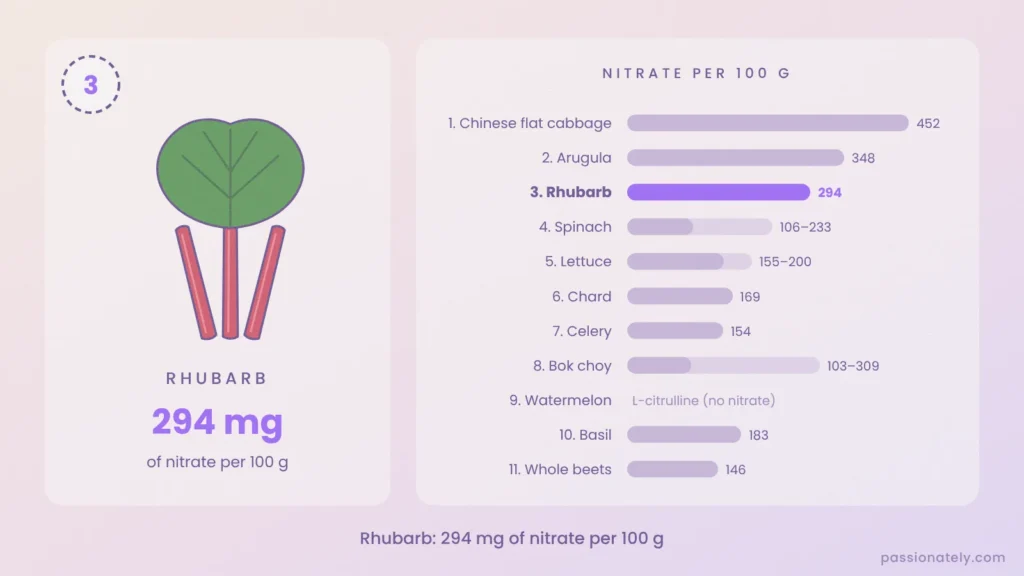
Rhubarb has 294 mg of nitrate per 100 g.
2. Arugula (Rocket)
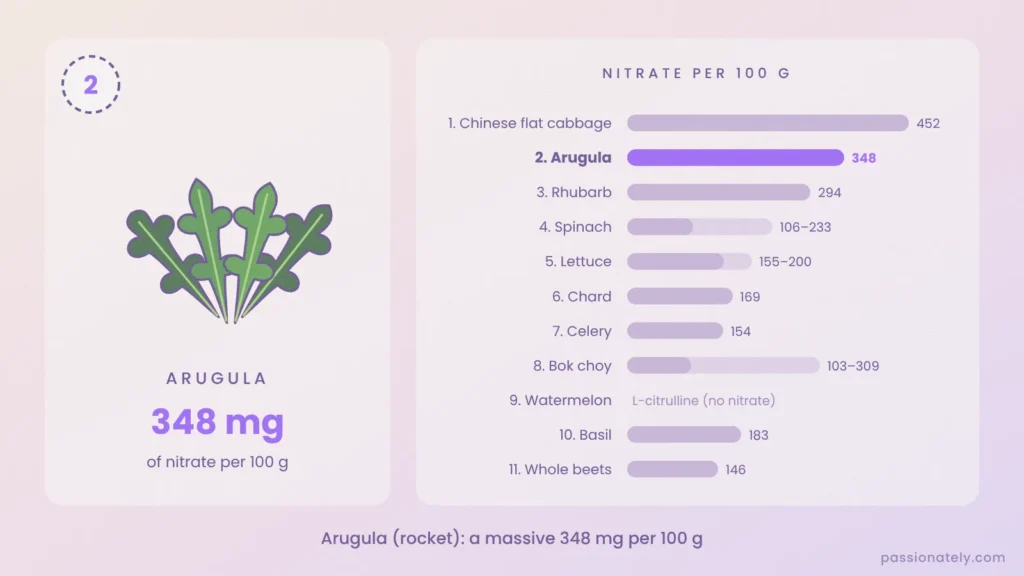
Arugula, or rocket, has a massive 348 mg of nitrate per 100 g. Again, this is great to add into your wraps, add into your salads.
I even had it in a pasta dish last night, which was excellent, and I enjoy it with my breakfast. I try and add a little bit of arugula to at least one meal that I’m having each and every day to get my nitrate consumption up.
1. Chinese Flat Cabbage
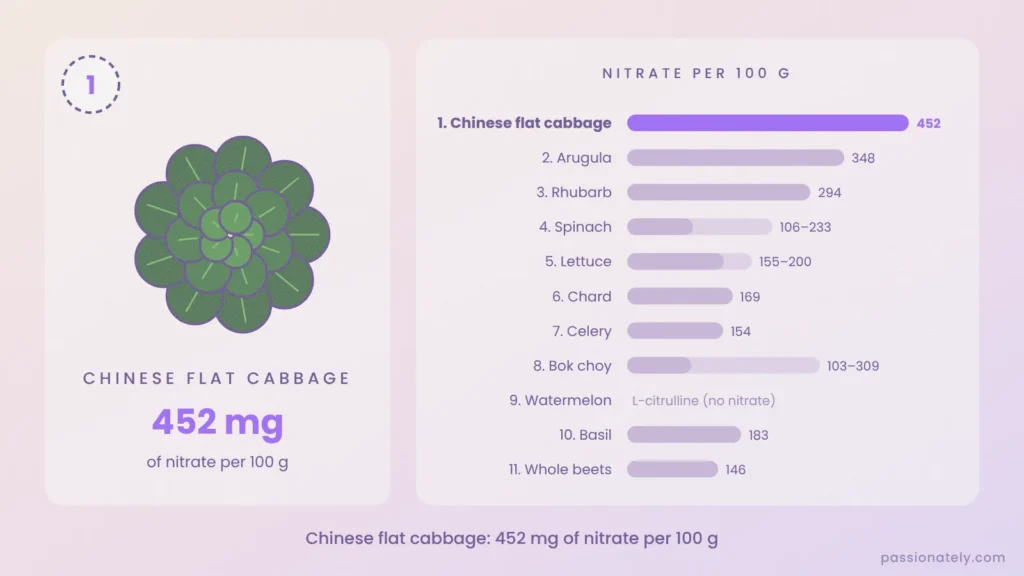
This one is a little less common: Chinese flat cabbage comes in at 452 mg of nitrate per 100 g.
Eating foods high in nitrate isn’t the only way to boost your nitric oxide. Go ahead and check out this article I did on the six ways to naturally boost nitric oxide in your body, or go ahead and see the full list of supplements that I take to not only boost my nitric oxide levels, but also to improve my erections.