Is My ED Permanent? Signs It’s Fixable
Your erectile dysfunction probably isn’t nearly half as bad as you think it is, and there’s a simple questionnaire that you can do from the comfort of your own home to work out exactly how bad your erectile dysfunction is or isn’t and how you can treat it.
There’s a catch though.
See, while doctors, urologists and psychotherapists all use this questionnaire with their patients, they make one big mistake that leads most guys to think that erectile dysfunction is way worse than it actually is.
Fixing this one little mistake helped me overcome my erectile dysfunction and is helping thousands of guys more accurately work out what their issue is and how they can regain healthier, harder erections.
The SHIM Score
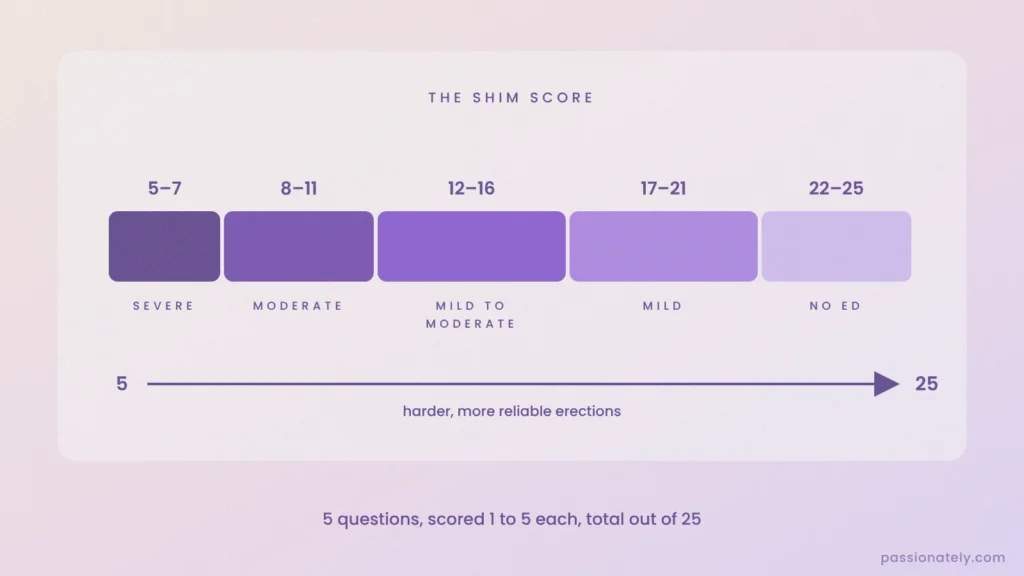
It’s called the SHIM score, or the IIEF score, and it’s a simple five or six part questionnaire that will show you whether or not you have ED and how bad your ED actually is.
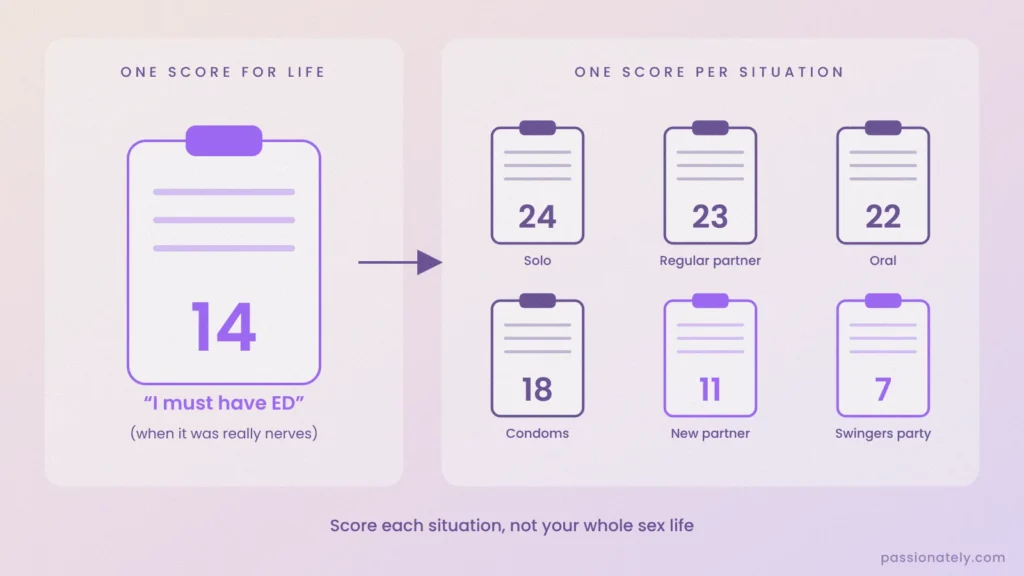
However, the one big mistake I think clinicians and patients are making, and the one mistake that I think you should avoid, is they’re doing this score just once for their life in general.
I’ve seen so many guys have issues the first time they’re with new partners or in certain situations and label themselves as having erectile dysfunction, and they think that they have issues down there, that the plumbing is not working, when really they just have performance anxiety and issues with their mind.
For most guys, their erectile dysfunction presents very differently depending on the different situations that they’re in. If you’ve ever lost your erection with a partner but you’ve been fine getting it up by yourself masturbating and watching porn, then you’ve already experienced this.
For me, I was perfectly fine having sex with existing partners, had no issues at all, but anytime I would connect with someone new and was having sex with them for the first time, I would have performance issues and wasn’t able to get it up or stay hard all the way through.
Do The SHIM Score For All The Different Situations
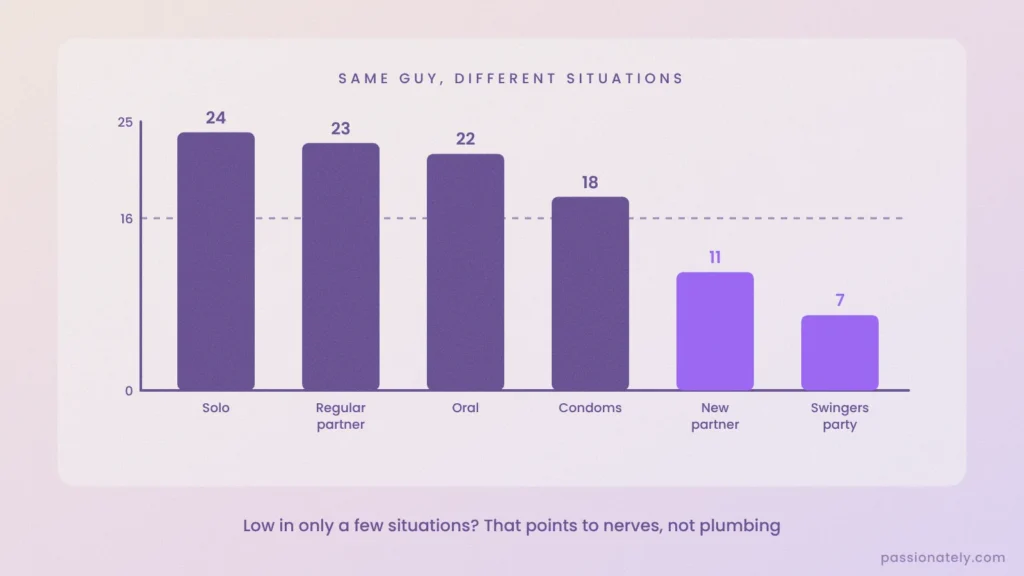
Rather than making this huge mistake of just doing the questionnaire once, here’s what I do instead.
I do the SHIM score questionnaire for all the different situations in my life where I want to get and maintain an erection. By doing this multiple times, the different scores are going to show me exactly where my problems lie and what might be the cause of them.
Some common examples include things like when you’re by yourself masturbating, when you’re with a regular partner, when you’re with a new partner.
You might want to do the SHIM score for blowjobs or oral sex versus when you’re having intercourse to see if there’s any difference there. You might want to do the SHIM score for when you’re using condoms or when you’re having sex without condoms.
And for those more adventurous, you might want to do the SHIM score for things like threesomes, orgies or swingers parties or outdoor quickies and things a bit more risqué.
This is because how you feel in the moment has a massive impact on how strong your erections are going to be.
For example, it’s extremely common for men to go to a swingers club for the first time, be really excited by the opportunity to sleep with multiple people and be completely unable to get it up. This is because they’re nervous. There’s a lot of anxiety and emotions going on.
And if they were to do the SHIM score just for one time across their entire life, they might look at it and say, “Yes, I have erectile dysfunction. I have problems getting an erection,” but really, by doing it in multiple situations, they might say, “Well, actually, I have no issues with my partner. It was just this one time at this party that I really struggled.”
This means that, hey, I don’t need to stress about having erectile dysfunction. Everything’s working fine.
But maybe if I’m going to go to a party again, I might need some pharmaceutical help from something like Viagra or Cialis just to get me through that situation. But I don’t need it in every situation in my life.
Here’s the SHIM score questionnaire.
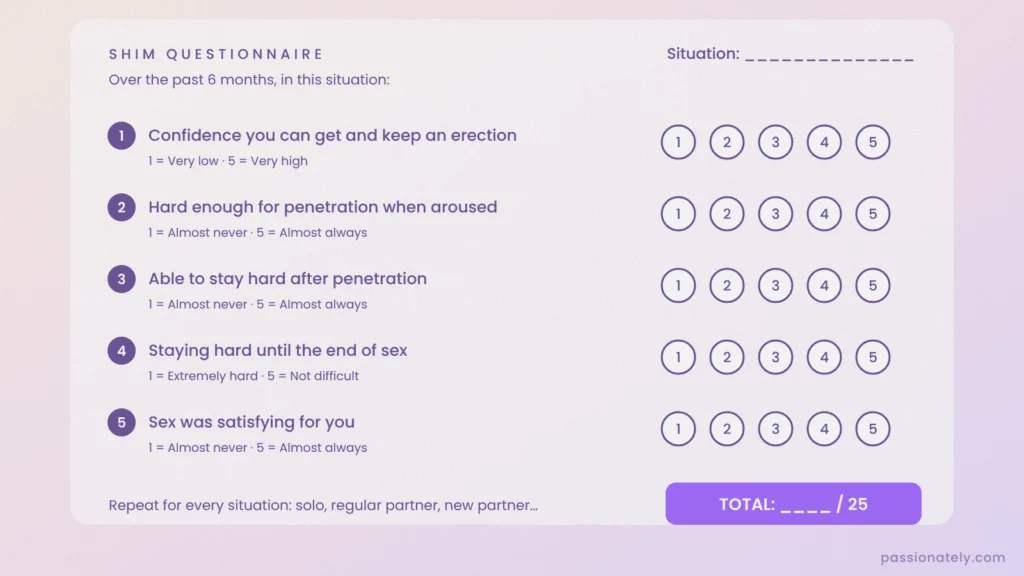
Do the score for all of these different situations that occur in your life. Your results are going to help you identify what kind of erectile dysfunction you have and what are going to be the best treatment options for you. So you can go ahead and fix it.
What Your Results Mean
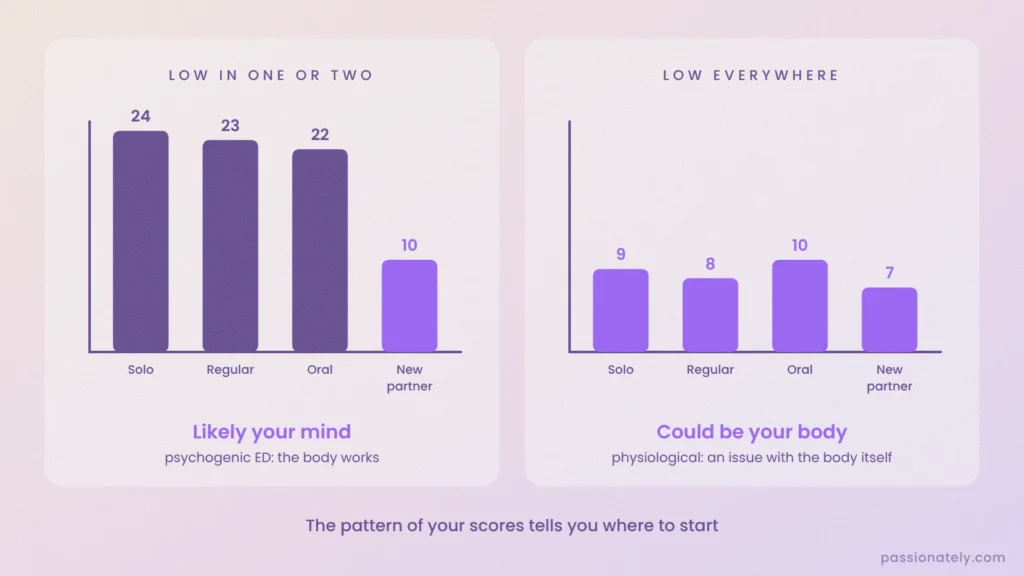
The SHIM score is rated on a scale from five up to 25.
If you have high scores or mild to no ED in most circumstances, and then you’ve got low scores in just a couple or one circumstance, then this likely means that you’ve got psychogenic ED, or erectile dysfunction caused by your mind.
This means your body is fine. You just need to learn to work through the worry and anxiety that comes with the situation that’s causing your erectile dysfunction.
In this situation, there’s a few simple exercises you can do before and during sex to help you more easily get and maintain your erections or to regain your erections if you lose them.
Inside my free ED toolkit, I share some of these mental exercises as well as the best supplements and physical exercises that you can do to get healthier, harder erections. Go to passionately.com/ed and you can get your free copy today and work your way to healthier, harder erections.
However, if you’re finding that you’ve got low scores in all situations, or you’re struggling to get and maintain an erection and it’s not situation-based, then that could indicate a physiological issue or an issue with your body itself.
Where you start on the SHIM score can also impact the improvements that you’re likely to see.
Moving up a few points on the SHIM score is achievable for a lot of men, but if you’re super low, like in that five to 10 range, then getting up to those higher scores of 22 to 25 is going to take more work or it may take more treatment options.
Also, some treatment options work better for mild erectile dysfunction while other treatment options work better for moderate to severe erectile dysfunction.
So, understanding how severe yours is is really important, and once you’ve done that, go ahead and check out this video that I created explaining all the different treatment options available for erectile dysfunction so you can work out what’s going to be best for you.